Showing posts with label Raisin in the sun. Show all posts

23 March 2010

Raisin in the Sun...Twittered

Introducing a new literary innovation......
TWITTERATURE
....retelling some of the world's greatest stories in 20 "tweets" or less, and the only rule is that a tweet can have no more than 140 characters.


Click below for Twitterature Versions of Dan Brown & JK Rowling's great works-

The Da Vinci Code by Dan Brown
@CatholicGuilt


OR

Harry Potter by J. K. Rowling
@NotoriousHP


But what are people saying about TWITTERATURE?

"Do you hear that? It’s the sound of Shakespeare, rolling over in his grave." – The Wall Street Journal

"A tool to aid the digestion of great literature" – Guardian

"Fans of the classics will either be delighted or appalled." – Guardian.co.uk/media

Are these guýs brilliant or lazy? Neither? Or both?
One thing is for sure...you must really know a story well to be able to twitter it in a way that the real story is maintained. Let's see how well you can do it.

Writing assignment for A Raisin in the Sun-- TWITTER the PLAY.
Retell me the story of the Younger family in the same way these two 19 year olds retold classics like Hamlet, Pride & Prejudice, and The Adventures of Huckleberry Finn.

You must have AT LEAST 15 TWEETS but NO MORE THAN 20 TWEETS.
Each tweet cannot exceed 140 characters.
If you use any abbreviations, you must give an explanation for each at the END of your story.
Your twitterature version of A Raisin in the Sun must take me from the Act 1, Scene 1 to Act 3 and must include the events/scenes/quotes that are critical to the storyline.

21 March 2010

Still I Rise

What connections can you make between the Lorraine Hansberry's A Raisin in the Sun and this poem by Maya Angelou?

04 March 2010

African Americans get the vote....

Once African Americans were given the right to vote, less than 5% of them actually exercised that right because southern states set up literacy tests that had to be passed in order to vote. For the white man, these tests were not a problem, but for a black man or woman these tests were a huge barrier. After years and years of slavery followed by years of inequity in education and schooling, many blacks did not know how to read or write. This helped the white man ensure that although the black man had the right to vote, he would never be able to act on it.....

Because of these situations throughout the south, many Civil Rights' activists were determined to make a change. They set up voting clinics throughout the south were they worked with African Americans, helping them to pass the literacy tests and become officially registered to vote. Their efforts were met with violent repression from state and local lawmen, White Citizens' Council, and Ku Klux Klan resulting in beatings, hundreds of arrests and the murder of several voting activists as seen in this clip from the film "Mississippi Burning".


After watching this clip, discuss in your groups how it is possible to have laws on paper that are not enforced in practice. What examples of hypocrisy do we see in government and policy in the 1960s and still today? How can this double standard be stopped? Or can it be?

04 February 2010

Ending Jim Crow??

The only way to ensure that the past and its mistakes do not repeat themselves is to educate ourselves about the "stories" that occurred.... One such example of this is the story of Medgar Evers, Civil Rights Activist.

Emerging from his car and carrying NAACP T-shirts that read "Jim Crow Must Go," Evers was struck in the back with a bullet fired from rifle near his home his Jackson, Mississippi. He staggered 30 feet before collapsing. He died at a local hospital 50 minutes later, just hours after President John F. Kennedy's speech on national television in support of civil rights.


Your task:
Think about the price people have paid in the fight for freedom, equity, and peace....many of them, the ultimate price which is human life. So why fight if the risk can be so great? Is this fight really about achieving an American Dream or is it something altogether different? Something bigger?

As a group you must research one person who fought in this fight in the 1960s for equality and acceptance for the African Americans. You will ultimately present your person to the class in a formal presentation, but right now, your focus must be on finding your person. You will be given the guidelines for your presentation the next time we meet and the only rule is that you cannot choose Martin Luther King, Jr. as your person.


Your job will be to bring this person alive to the class and tell his/her story in a way that after the presentation is over, we feel as if we "know" this person. For now.... agree on a person and be ready to present the name to me at the beginning of the next class. It would be a good idea to have a second and third choice just in case another group chooses your person ahead of you.....

Jim Crow Laws....seriously??

The Civil War in the United States was fought from 1861-1865.
In 1863 President Abraham Lincoln signed the


which formally abolished slavery in the United States and declared all men free when it said:

"That on the 1st day of January, A.D. 1863, all persons held as slaves within any State or designated part of a State the people whereof shall then be in rebellion against the United States shall be then, thenceforward, and forever free...."


So how is it possible that ONE HUNDRED YEARS LATER, the Jim Crow Laws could still be in effect?

Your group's task:
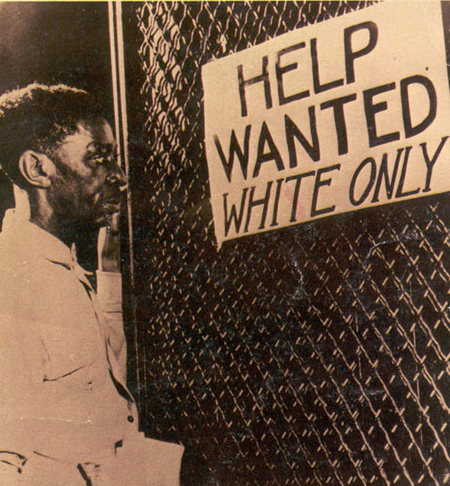
Look at each of the following pictures which are examples of Jim Crow Laws throughout the southern United States in the 20th century.
How do they make you feel?
What do they make you want to do/say when you see them?


What about statements such as these about Jim Crow Laws:
1. One rationale for the systematic exclusion of Black Americans from southern public society was that it was for their own protection.....
2. Allowing Blacks in White schools would mean constantly subjecting them to adverse feelings and opinions which would not be fair for them to experience....

How do these make you feel when you hear them? What could members of society do to actually change these opinions, these laws, and these ways of thinking?!!? Could they do anything?

31 January 2010

Who was Jim Crow?


It is important to understand what was happening in the US at the time that A Raisin in the Sun is set and the place to start the understanding is finding out... WHO WAS JIM CROW?

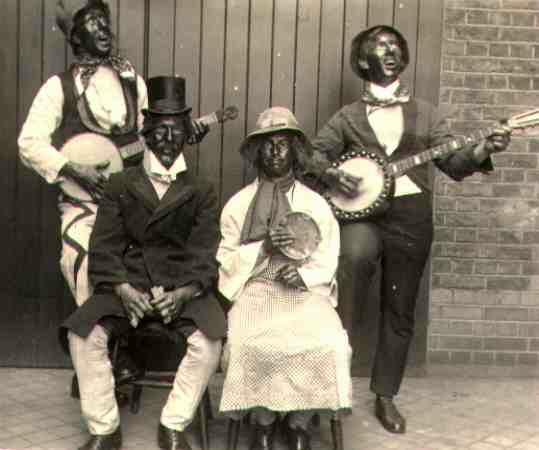
Task 1- Describe this picture of "Jim Crow" and discuss in your group how you feel when you look at it. Are the feelings positive, negative, happy, entertaining, degrading, or something else? Why?


If you were to learn that this image represents a white man dressed up with black paint on his face, meant to mimic the black man, does that change your thoughts about the image at all?

A little background information:
The minstrel show was an American entertainment consisting of comic skits, variety acts, dancing, and music, performed by white people in blackface. Minstrel shows lampooned black people in mostly disparaging ways: as ignorant, lazy, buffoonish, superstitious, and musical. The minstrel show began with brief burlesques and comic acts in the early 1830s and emerged as a full-fledged form in the next decade.

The typical minstrel performance followed a three-act structure. The troupe first danced onto stage then exchanged wisecracks and sang songs. The second part featured a variety of entertainments, including the pun-filled stump speech. The final act consisted of a slapstick musical plantation skit or a send-up of a popular play. Minstrel songs and sketches featured several stock characters, most popularly the slave, mammy, old darky, and the mulatto wench.

Read THE MINSTREL SHOW IN AMERICA for more information.

TASK 2: Watch 2 examples of an old Minstrel skit.
As you watch it, think about the following items to discuss with your group:
1. Is this type of entertainment appropriate or not?
2. What is the message behind this type of entertainment?
3. Should it have been allowed?
4. What was its purpose?
5. How did it make you feel as you watched it?
6. And finally..... would you have felt differently if you were an African American watching this?


TASK 3: Look at the following images associated with "Minstrel entertainment".

In your group divide these images into two categories:
1. Appropriate and Tasteful Advertisement OR 2. Blatant Bigotry
and be prepared to justify your choices.